- First step was download the bits and "install" (i.e. unzip) them (the "bits" I used were the core libs plus the utils. In my case "jibx_1_1.zip" and "jibxtools-beta2.zip"
- Copy the jibx-genbinding.jar and jibx-genschema.jar files from the tools zip file to the ./lib directory of your main JiBX "install"
- Open a command line and change directory to where your compiled classes are (NOTE: not the java source files as jibx uses introspection with the class files to do it's work. If they are in a package structure, make sure you are at the root of the package structure so that the cp declaration in the following command works. Otherwise you'll get a JiBXException about classes not being found)
- Auto-generate the binding file ("binding.xml") for your classes by running the following command:
- java -cp . -jar /home/myexampleuser/jibx/lib/jibx-genbinding.jar com.myexample.ClassA com.myexample.ClassB
- I had warnings at this stage about references to interfaces or abstract classes:
- Warning: reference to interface or abstract class java.util.Set requires mapped implementation
- I'd gone outwith the standard example on the website. Time to hit google... It turns out that out-of-the-box JiBX can handle some java.util.Collections fine like ArrayLists which my model also used but java.util.Sets (I'd used HashSet) were a little more troublesome. I needed to edit the newly created binding.xml file each time a Set-based relationship was found as follows:
- Original: <structure field="mySetOfAObjects" usage="optional">
</structure> - Updated: <collection field="mySetOfAObjects" factory="com.myexample.ObjectB.hashSetFactory">
<structure type="com.myexample.ObjectB" usage="optional"/>
</collection> - You'll have noticed that I seem to be calling a method "hashSetFactory()" on ClassB. This is the case, and it won't be there already. You need to add a static method to this class as follows:
- private static Set hashSetFactory() { return new HashSet();}
- You'll now be able to run the second command which will generate your xsd schema for you based on your new mapping binding.xml file:
- java -cp . -jar /home/myexampleuser/jibx/lib/jibx-genschema.jar binding.xml
- This will then generate you the xsd schema file you have been looking for all along.
Tuesday, 17 October 2006
JAXB, JIBX and Reverse Engineering XSD from my Java Object Model
Monday, 21 August 2006
Imagining Using the Portlet 2.0 (JSR 286) Early Draft 1 Spec Release
Lets describe my imaginary app. (The standard kind of portler app I've worked on.) The setup is simple. There are three portlets. A “search” portlet and two content portlets: “films” and “actors”. You can use the search portlets single search field, coupled with a radio button selection of the search type (c.f. google) to search for either actors or films. The results of your search are displayed in the same portlet as a clickable list.
This is where the new "Portlet Co ordination" model comes in. The new spec (as I understand it) has added the concept of events which can be "thrown" (my terminology - almost in the same way as exceptions or events which are listened for in Swing apps is the impression that I get). These are then handled in an additional phase in the request action handling - rendering cycle which occurs after the relevant processAction() method is called, but before all the doView(), doEdit() etc. calls are made to generate the page fragments. As with wires, you can set attributes in the event (as standard types or even XML which is marshalled with JAXB - nice and flexible) which can then be picked up by those portlets which have elected (declaratively in the portlet.xml - again, nice and flexible) to react to specific
goings on which have happened (not only as a result of user interaction, but also emitted from the portal framework itself (c.f. pp. 75) The spec indicates that portlets can send what are termed "dynamic" events which are not declared in portlet.xml or, more usually static "declared" events. Finally I should note that a portlet can throw more than one event per processAction() call. Something which made things even more complicated with Websphere wires.
Clearly this is brilliant. How do we do it? Well, there's a new lifecycle interface for our portlet classes: javax.portlet.EventPortletInterface. This provides a new method which we must implement: processEvent(). To reinstate our old wired portlets, we need to take the Portlet classes we'd written, add the implementation of the interface, do some fairly hefty refactoring to move a lot of the code in many of the portlets processAction() methods to the new processEvent() method, declare our sending and receiving of events in the portlet.xml file and then deploy. Hooray! The complex WSDL for the exports and imports of data which WebSphere used for wiring is no longer required.
The final beauty of this new model is that the portal will now be happy to dynamically propagate any events as requested during operations. No more intervention is required after a successful deployment. (This is a vast improvement on WebSphere wiring jungle which would be remembered after subsequent deployments, but if you wanted to change a wire, you had to undeploy the entire portlet application and remove your portal pages again, then redeploy, put the pages back and then re wire using the admin GUI. If things still didn't work, then you'd have to undeploy, destroy and then repeat again. This wasted a lot of time.)
You should have guessed that I'm very happy that this has been added to the 2.0 spec. But while I do admit that it does seem a vast improvement on the way I have described above, I fear a few tricks have been missed in keeping this simple. Firstly, one of the few things I did like about the wiring method was that the wire effectively allowed you to call processAction() on one portlet, set a request parameter which would tell the wire to then call the processAction() on another portlet. It made sense to me and did not mean I had to understand (and debug) an increasingly complex class flow. Indeed, there could be multiple calls (as I outlined above where a click in a search result would get one portlet to display some detail and the other to reset itself) and each would follow the same route, initiated by the same original interaction from the user. The point I'm trying to make is that I'm not entirely convinced that there is a requirement for another portlet method, and its associated interface to implement. What is so vastly different between "actions" and "events" which means that they have to be handled separately?
Portlet development, even in the simplest sense is more complicated that it is with servlets - and rightly so, due to the slightly more complicated request - (action - render) - response cycle. But the aim should be to keep a sensible level of simplicity, otherwise potential developers will be driven away and the spec under used. Something JEE is only just recovering from. Consequently, it seems to me, that were the two new concepts of Portlet Co ordination and Shared Render Parameters (see below) to be linked and allow the proposed mechanism to call the processAction() methods rather than the additional processEvent() methods. The associated benefits of bookmarkable URLs (see below) could be leveraged and the present processing mechanism would be maintained. Code which was written for 1.0 could be simply updated (or in my case, little new would have to be done, we could just replace the wires with the new entries in portlet.xml to let on about who did the sending and who the receiving. Sorted.
Which brings me onto my second and final (and far shorter) area of feedback. I've already discussed what a nightmare getting the WebSphere wiring to work could be. It certainly seems vastly simpler with the "auto wiring" in the 2.0 spec, and the necessary xml configurations in portlet.xml are vastly simpler than the previous WSDL nightmare. But are the configurations necessary at all? Why do we still have to hack XML? - EJB3 showed us that annotations and sensible defaults can get us a great deal. I would also like to see the same sort of support in Portlet 2.0. Perhaps this is a way of implementing the (possibly necessary complexity) which led to the additional processEvent() step. As with EJB's, the Home, RemoteHome, and other interfaces are still there, it's just that the developer never needs to think about them, unless they choose to.
Before I close, I'd like to mention a few more quickies. Firstly, support for Java 5 - excellent - but why no support for JEE 1.5 rather than 1.4? Surely this would be an ideal to piggy back on what looks to be a storming, remarkably simplified and vastly more usable spec. The fact that the JPA can now be used outside an EJB container is a vast improvement. If portlets could then simply use this for the "M" in their MVC (we just used Hibernate and POJOs when we did our development) then everything done would be far more futureproof and allow portal implementations to run on Web Container only platforms.
Secondly, it is also very welcome to see the ability to share session state and render parameters. The possibililty of bookmarkable portlet URLs is an attractive one and will greatly increase usability and greatly simplify trying to handle the ever present threat of a user pressing the dreaded "back" button. The ability to share parameters outside the current portlet application is also a great improvement on a previously frustrating and seemingly arbitrary restriction.
All in all, I think this is a very promising looking 2.0 spec. I for one look forward to doing more portlet development in the future and coming up with even wilder ways to try and push the limits of what it can do.
NOTE: I haven't commented on the proposed AJAX or WSRP support. Both would be most welcome however and help the spec to be relevant to an even wider audience.
Wednesday, 26 July 2006
Tuesday, 11 July 2006
EJB 3.0: One Model Inside and Out (Pt. 2) - The POJO Model Itself – Annotations and Relationships
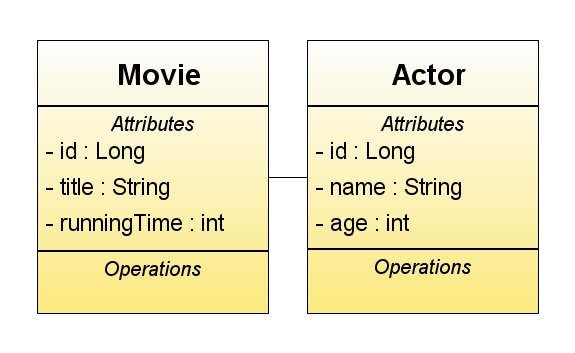
I hate databases. We don't get on. They don't respect me, and as a result I don't respect them. Therefore I always like to start my OO apps. by encapsulating the domain model in a class model. For the Loads-A-Movies project mine was very simple:
If it looks simple, it's supposed to. Lets create the classes.
Creating the Movie Entity Class
This will represent the table “MOVIE” in the database. We first need to generate a simple, serializable java POJO class with the attributes shown above encapsulated as appropriate (you can do this automatically with your chosen GUI). This now needs to be annotated to let the compiler know how to treat it. (Note: This requires JDK annotation support which you'll get if you use Java 5)
...
public class Movie implents Serializable {
private Long id;
private String title;
private int runningTime;
public Long getId() {
return id;
}
public void setId(Long id) {
this.id = id;
}
...
First up we need to let on this is an Entity Class. We do this simply by using the “@Entity” annotation before the “public class Movie implements Serializable” line. The compiler is now clever enough to know that, unless told otherwise, the attributes on this class will be represented as columns in our table. That's how EJB 3.0 works. It assumes the default, unless you tell it different. Very handy.
...
import javax.persistence.Entity;
...
@Entity
public class Movie implents Serializable {
...
The observant amongst you will realise that we most likely need a primary key. Correct, each entity class must have a primary key. When you create the entity class, we must add an @Id annotation to the “id” attribute to declare we plan to use it as the primary key. We also add the @Generated... annotation to specify the key generation strategy for the primary Id. In our case:
...
import javax.persistence.GeneratedValue;
import javax.persistence.GenerationType;
import javax.persistence.Id;
...
@Id
@GeneratedValue(strategy = GenerationType.AUTO)
private Long id;
...
Finally for Movie, there is the interesting case of the relationship with the Actor Entity class. Firstly we need to add the collection attribute, “Collection
import javax.persistence.OneToMany;
...
@OneToMany(mappedBy="movie")
private Collectionactors;
...
And that's the Movie Entity class coded. We now need to do the same for the Actors. As before, create a POJO class (ensuring you “implement Serializable”) with the required attributes encapsulated. This will represent the "ACTOR" table in the database. Again define it as an Entity with the @Entity annotation and mark the “id” attribute as the primary key and set it to
be auto generated with the @Id and @Generated tags.
Again we need to add the new attribute. in this case it's the Actior nowing about the film he has appeared in:
private Movie movie;
Again, encapsulate this attribute. Finally we need to add the annotation to let on that this is the reverse direction of the previous relationship. We do this by putting the following annotation above the new movie declaration:
import javax.persistence.ManyToOne;
...
@ManyToOne
private Movie movie;
Note: You'll have noticed that you require imports for these annotations. These are contained in the “javaee.jar” package which I needed to declare as a dependency in my maven project.xml file. I found the one I used in my GlassFish server's /lib directory. If you're doing it differently maybe your IDE has suggested one for you.
That's all for this entry. There is far more information on the possibilities of EJB 3.0 persistence which I haven't gone into. The best sources for more information I have found are as follows:
- Java Persistence in the Java EE Platform - tutorial at netbeans.org
- Standardizing Java Persistence with the EJB3 Java Persistence API - Article at OnJava.com
- The Java Persistence API - A Simpler Programming Model for Entity Persistence - Article at java.sun.com
EJB 3.0 - One Model Inside and Outside the Container (Pt. 1)
First up, lets have a quick overview of what I'm trying to achieve. The plan is to create a website to store information about my film collection. I want to be able to do all kinds of fancy things but really it's an excuse to fiddle around with Java 5, generics, annotations, JSF, EJB 3.0 and Maven. I have a cunning plan however. I love the idea of the Flickr uploader but I want to take it further. What if I could have a local, thick Swing app. which I could keep in sync. with my web app. and use to upload and maintain info on my public website? It could use the same model code... That would be cool. It would also let me fiddle with the Matisse GUI builder, Derby and most importantly the Napkin look and feel...
So how am I going to approach this? Well, the plan is to have three separate maven projects, with all the common stuff factored out into a code-less master project (I won't go into this any further, that's a separate blog entry). The first is to be the model project; “loadsamovies-model” which we will discuss in the next blog, the second the web presentation layer; “loadsamovies-presentation” which I don't plan to go into as the techs and methods is covered in great detail elsewhere. The last is the uploader Swing app; “loadsamovies-thickclient”
See the next entry for how I coded up the model.
Sunday, 9 July 2006
Booting Apache Derby ("JavaDB") with your Java App's Startup
// Start the Derby Database
try {
Class.forName("org.apache.derby.jdbc.EmbeddedDriver")
.newInstance();
} catch (ClassNotFoundException ex) {
ex.printStackTrace();
} catch (InstantiationException ex) {
ex.printStackTrace();
} catch (IllegalAccessException ex) {
ex.printStackTrace();
}
// Set the connection to the database
Connection conn = null;
try {
conn = DriverManager
.getConnection("jdbc:derby:sample;create=true");
} catch (SQLException ex) {
ex.printStackTrace();
}
It's important to notice (as I didn't to begin with) that you need the local version of the URL as you are doing this using the embedded driver. If you use the URL version you'll get a "java.sql.SQLException: No suitable driver" error.
You'll also notice that this creates the database with the name provided in a directory with the name provided, (e.g. "sample"). This directory will be in the same place as the main class you are running.
One final thing, this is dead easy to use with EJB 3.0 too. All you need to do is set up your persistence manager to run outside a container and as soon as you have started your embedded database, you can connect to it with something like TopLink. Beautiful....